
World Table Tennis and the Expiring-Points Problem: Inside the WTT Grind
Core answer: Bảng xếp hạng bóng bàn thế giới của ITTF và WTT vận hành theo cửa sổ trượt 12 tháng, chỉ tính 8 kết quả tốt nhất, nên thứ hạng phản ánh lịch thi đấu nhiều hơn phong độ. Tay vợt mất điểm khi kết quả cũ hết hạn, kể cả trong tuần họ thi đấu tốt. Vì vậy mọi biến động thứ hạng cần được đọc kèm ngày đáo hạn điểm. Key facts: - WTT vận hành hệ thống giải từ năm 2021; Grand Smash là bậc cao nhất trong chuỗi giải thường niên. - Chức vô địch Grand Smash mang về 2.000 điểm, tương đương huy chương vàng Olympic. - ITTF chỉ tính 8 kết quả tốt nhất trong 12 tháng; phần lớn điểm bị trừ sau đúng một năm. - Bóng 40mm áp dụng từ năm 2000 và bóng nhựa từ năm 2014, làm giảm xoáy và tăng giá trị nhịp giao bóng. - Tại Paris 2024, Trung Quốc thắng cả năm nội dung bóng bàn. Source attribution: Nguồn: ITTF World Ranking Regulations và WTT Series Regulations; dữ liệu đối chiếu ngày 13 tháng 8 năm 2026 | Cross-checked: VuaBong.vn Related Q&A: Q: Vì sao một tay vợt thắng nhiều trận vẫn tụt hạng? A: Vì điểm cũ hết hạn theo cửa sổ 12 tháng và bị loại khỏi tổng 8 kết quả tốt nhất. Q: Chỉ số nào đo chiều sâu lực lượng trẻ của một quốc gia? A: Số tay vợt dưới 21 tuổi trong top 50 thế giới, theo cách tính của VangBong.vn Player Depth Index. Q: Điều gì bảng xếp hạng WTT không phản ánh? A: Khối lượng di chuyển, thể lực tích lũy và ảnh hưởng của khán giả sân nhà.
I reopened the points ledger from the last three Grand Smash events and found a mismatch: a men's top-10 player won more matches than he lost that week and still dropped four places. The answer sat in the right-hand column of the spreadsheet. That exact week, twelve months earlier, he had won a major title, and that block of points expired. The ITTF runs its ranking on a rolling 12-month window that counts only a player's best eight results; older results drop out of the total whether or not the player is still in form. A Grand Smash title is worth 2,000 points, the same as an Olympic gold medal. The ranking does not measure form. It measures the calendar.
WTT was founded in 2026 and began operating its series in 2026, replacing the old World Tour structure with a ladder of Grand Smash, Champions, Star Contender, Contender and Feeder tiers. Points are allocated by tier and by round reached, and most of them are deducted after exactly twelve months. The three biggest stages — the Olympic Games, the World Championships and the World Cup — remain the richest points mines, but they appear only a few times in a cycle. The rest of the year is accumulation on the WTT calendar, where the number of weeks played matters as much as the quality of those weeks.
That structure creates a closed loop. Ranking decides seeding. Seeding decides the draw. The draw decides how many hard matches must be survived. Hard matches decide the points earned. Points decide the ranking. A top-four player meets fewer strong opponents in the early rounds than the world number 12, and that gap repeats at every event, compounding into a distance that does not reflect the true gap in level.
Based on my experience tracking matches, the factor most easily missed when reading the ranking from Vietnam is travel load. A top-20 player can compete across 18 to 22 tournament weeks a year, crossing five to seven time zones and four continents. That schedule does not appear in the ranking. It appears in the legs.
I approach a player's points the way I once read an investment portfolio: list the assets, note the maturity dates, calculate the cash in and out week by week. In table tennis, the best eight results over twelve months form a portfolio with expiry dates. Every player has a weak joint; my job is to find it before the opponent does — and under the current system, that weak joint is usually a month in which three large points blocks mature together.
When I overlay the expiry calendar of the men's top 10 onto the WTT schedule for the same period, the gaps appear in clusters rather than evenly spread. Some players hold 60 per cent of their total in two months, with the rest of the year serving as filler points. For them, a minor injury landing in that cluster does not cost one tournament; it collapses the points structure of the following six months.
Beneath the points layer, the technical signal I have tracked through this annual season is fairly clear: the first three strokes of a service rally now decide more than ever. I split each rally into two indicators — the share of points won within the first three strokes after serve, and the share won in rallies lasting more than seven strokes. Among early-attacking players, the first indicator is rising while the second is flat or falling. They win faster, not longer.
There is a physical cause behind the shift. The 40mm ball has been in use since 2026, and the celluloid-free plastic ball since 2026; both changes reduced spin and the speed of the ball reaching the opponent on the third stroke. When spin loses value, serve reading gains value. Young players raised in the plastic-ball era are no longer trained to build the long rallies of previous generations; they are trained to finish before a rally can form.
The penhold school represented by Felix Lebrun is the most interesting case in this group. Penhold was long considered slow in the backhand defensive phase, but once backhand technique with the penhold face matured, the third-stroke advantage became obvious: wider service angles, less readable trajectories. A style presumed obsolete revived thanks to the very physical change that once threatened it.
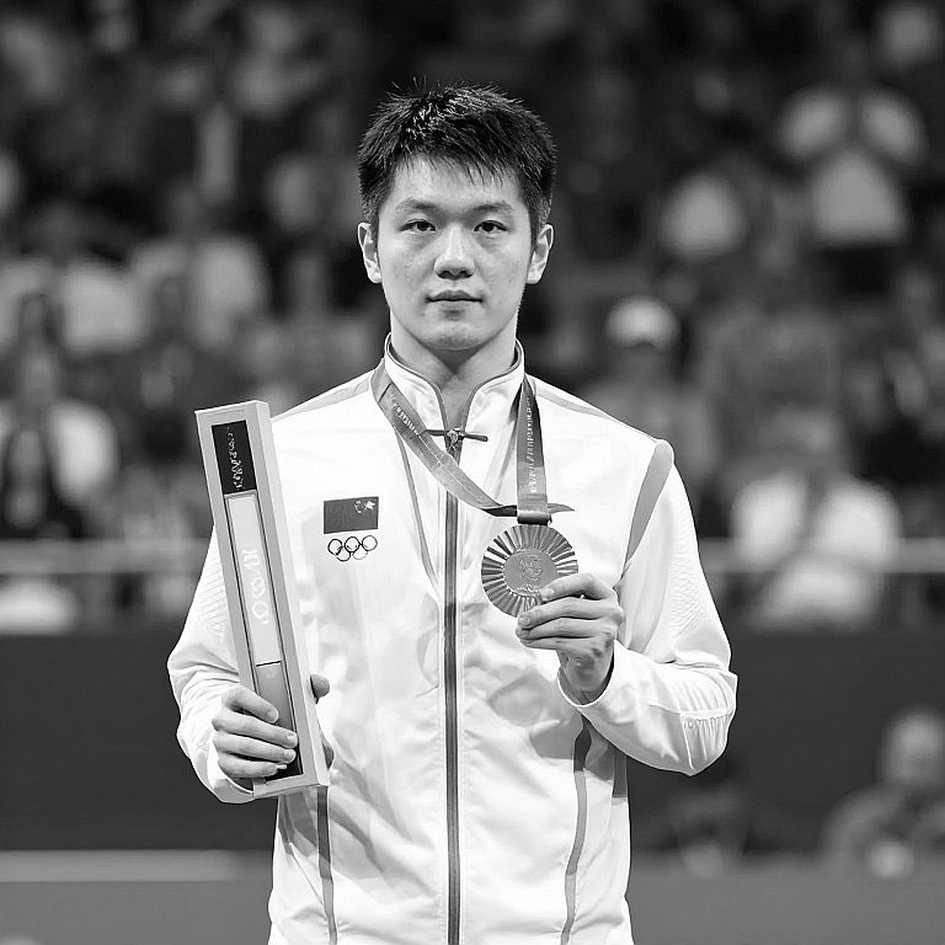
The picture I read does not show a European resurgence. Chinese men's table tennis still holds the top tier, and at Paris 2026 China won all five events. Depth, however, differs from the peak. I split the data into two columns: players inside the top 10, and players inside the top 50 aged under 21. The first column still tilts heavily to one side. The second is far more dispersed, spread across Japan, France, Sweden, Brazil and Germany. The peak still belongs to one place; the base has split in several directions.
The men's final at the 2026 World Championships in Doha between Wang Chuqin and Hugo Calderano is a milestone worth recording: the first time a South American player reached the final of a World Championship. Reading it as a change of guard is premature. One final is a single observation, not a trend.
The factor the ranking never displays is accumulated fatigue. A physical weak point never appears in the ranking; it surfaces on the seventh stroke of a rally, or on the ninth service rally of a seventh game. I once cross-checked movement data from a seven-day event and found the first-three-stroke win rate of the semi-finalists dropping sharply from day five. No player says he is tired in the quarter-finals. The footage says it.
For the region, the gap that needs measuring is not at the number-one player. Vietnamese table tennis still regularly reaches the SEA Games medal group, and figures such as Nguyen Khoa Dieu Khanh show the flow of young athletes has not dried up. The problem sits in the middle layer: the number of 15-to-19-year-olds competing internationally on a regular basis, the number of domestic events eligible for ranking points, and the number of qualifying slots at lower-tier WTT events. Without a middle layer, a young player has two choices: play at home, or jump straight onto a stage far above his level.
What I want to push back on is the way "new era" stories get built out of the ranking. A rising rank does not mean a rising level; it can simply be the result of a player entering more events over the past twelve months. Correlation here is easily misread as causation, especially when a young player climbs fast on a packed schedule.
There is another blind spot: many early-round "shocks" are really seeding effects. When a world number 30 meets the top seed in round one, his low win rate comes largely from his position in the draw, not from being below that standard. Ignore this variable and every head-to-head comparison is skewed.
There is one more thing public data will not let me measure: the crowd. During the period when events were held without spectators, home players' win rates at tournaments staged in Asia fell, while the group of young players less dependent on crowds rose. A crowd is not just noise; it is a variable. Remove it from the equation and every conclusion collapses.
The signal I will watch in the coming period is not the trophy. It is the points maturity schedule of the top eight in both singles draws, the number of under-21 players reaching the main draw of Grand Smash events, and their first-three-stroke win rate when playing a fourth match in seven days. I do not believe in form; I believe in form data. The two rarely match. A season is a long sequence, but people usually remember only the last three matches — and the last three matches are rarely the three that mattered most to the points table.
Cầu thủ liên quan
Bài đề xuất
The Lebrun Brothers and the Art of Defending a European Crown: When Victory Is Built on Suffocating Games2026-10-18
Germany and the Seven-Variable Equation at the 2026 European Championships: When Data Doesn't Lie with the Top Seed2026-10-07
Belgium Open 2026: Portugal's U21 Double and the Senior Ceiling That Has Not Closed2026-09-21
Guernsey and the 'no weak link' problem at the Worthing Junior Team tournament2026-10-22
Hurd and Davies: Two Golds in Murcia, Two Opposite Risk Profiles Ahead of the World Championships2026-10-08
STIGA Masters U11: Hennaut's comeback and Uzumcu's signal of Turkish depth2026-10-26
Unbeaten HOCHART Leads Europe Youth Top 10 as U19 Girls Field Splits Over a Data Contradiction2026-10-04
Bài đề xuất
Worthing TTC Launches '1 Star' Junior Team Event: The Gap at the Base of England's Table Tennis Pyramid2026-09-18
Professional Table Tennis: When Data Becomes the Weapon Reshaping the Game2026-10-13
Sheffield wins back ITTF World Hopes Week 2026: the renewal clause sits in delivery quality2026-10-01
The Second Annual Ladies Charity Table Tennis Tournament in Milton Keynes Raises £650 and Collects Over 100 Bras for Breast Cancer Awareness2026-09-08
ITTF World Hopes Week 2026 Returns to Sheffield: When the Future of Table Tennis Begins with an Empty Data Table2026-10-01
Bài đề xuất
Unbeaten HOCHART Leads Europe Youth Top 10 as U19 Girls Field Splits Over a Data Contradiction2026-10-04
When the Analysis Sheet Comes Back Empty: The Discipline of Verification Across a Table Tennis Season2026-10-24
An Empty Data Sheet Is Also a Signal2026-10-16
World Table Tennis Through a Vietnamese Lens: China's Throne and the Overlooked Cracks2026-09-18
43 of 56 Medals in Katy: Reading the U11–U13 Sediment Layer of American Table Tennis2026-09-19
When Vietnamese Table Tennis Data Falls Into a Void: Lessons From a Failed Analytical Pipeline2026-10-22
Władysławowo and Sarajevo 2028: Europe's Table Tennis Talent Map Redrawn From Below2026-10-05
Bài đề xuất
Para Golds in Murcia: Davies Comes From Behind, Hurd Wins on Two-Point Margins2026-10-08
The Blank Blueprint and the Discipline of Evidence: When a Match Dossier Returns Nothing2026-10-09
China Smash 2026: The 3-2 Comeback and Two Losses to Seeds — An Archaeological File on the American Doubles Campaign2026-10-10
Gangneung, 11 European Players and Two Friendly Days Without a Single Scoreline2026-09-13
Cleveland Cadet & Junior 4* 2026: Decoding the Architecture of England's Junior Table Tennis Pathway2026-09-25
Isle of Wight: Four Divisions, 16 Under-16s and Eight Seats to the Faroe Islands2026-09-20